

 Local Tips
 Kaş is a hard place to photograph well, and the reason is the same thing that makes it beautiful: white limestone, dark water, and a sun that sits almost overhead for most of the day. Point a phone at that between eleven and four and the camera does exactly what it is told, which is to average a scene with a five-stop range into something flat and grey.
Almost everything below is about timing, because timing is what separates the holiday photographs people keep from the ones they scroll past. It is specific to this town: the hours, the direction the sun actually travels, and the places worth standing. The sunrise and sunset times are included because looking them up is the one step everybody skips. If you are staying at Luna Kaş, most of what follows is within a twenty-minute walk.
The Light in Kaş, by the Clock
Türkiye stays on UTC+3 all year and does not change the clocks, so these hold from one year to the next. Times are for Kaş itself and drift by a minute or two either side of the dates given.
- 21 June: sunrise 05:45, sunset 20:23, last usable light around 20:55
- 15 August: sunrise 06:20, sunset 19:54, last usable light around 20:20
- 15 October: sunrise 07:09, sunset 18:28, last usable light around 18:55
- 21 December: sunrise 08:10, sunset 17:51, last usable light around 18:20
The forty minutes before sunset and the forty after sunrise are worth building a day around. So is the half hour after the sun has gone, when the sky still holds colour and the street lights come up at roughly the same brightness. That half hour is when the harbour photographs best, and by then almost nobody else is still out with a camera.
Midday is the problem. Between about eleven and four in summer the sun is high enough to put a hard black shadow under every eyebrow and blow out every white wall in the frame. If you have to shoot then, get into shade and let the shade do the work: a lane in the old town, a tree, an awning. There is one exception, and it is a significant one, further down.
Where the Sun Actually Goes Down
This one catches people out, and it costs them the evening. Meis lies southwest of Kaş, eight kilometres out, on a bearing of about 220 degrees. The sun never sets there. Even at the winter solstice, its most southerly sunset of the year, it goes down at roughly 241 degrees, and at midsummer it is out at 300, well round to the northwest.
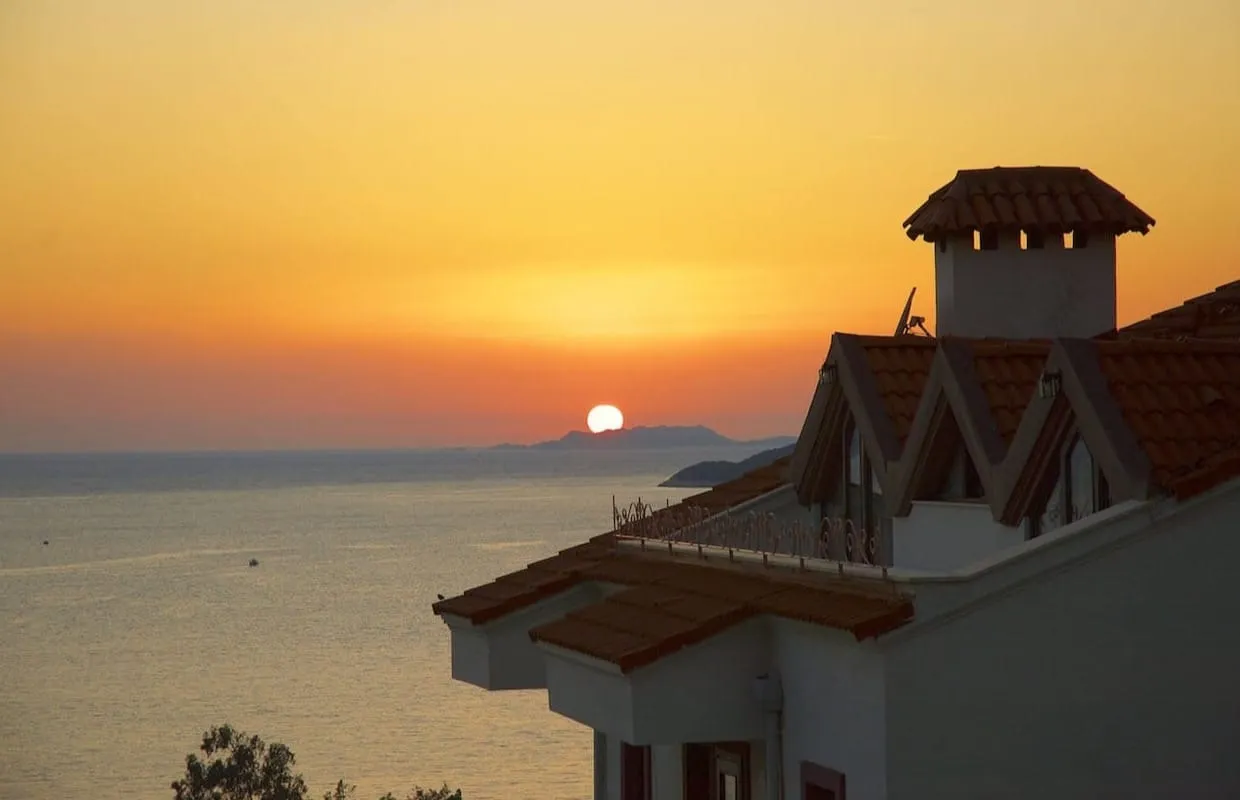
In practice that means summer sunsets from the town happen behind the ridge of the Çukurbağ peninsula, which sits at about 257 degrees. You get the sky, not the sun. Around the middle of October the sun drops almost exactly along the line of the peninsula. From late autumn through winter it clears the tip and goes down into open water, which is why the best sun-on-the-horizon pictures from Kaş are taken in the months most visitors are not here.
If you want the sun itself falling into the sea in July, go out onto the peninsula and shoot from its western side. Our guide to the Çukurbağ peninsula covers getting out there, and the same place is the best dark sky within walking distance of town.
Mornings work the other way round. The sun comes up behind the hills at about 60 degrees in June and 120 in December, so the sea is lit for a good while before the town is. That gap is the whole point of early mornings here, and it is why the harbour looks the way it does at seven o’clock.
Seven Places, and the Hour to Be at Each
Distances are from Luna Kaş.
Antiphellos theatre
1.1 km west, fifteen minutes on foot. Late afternoon, when the limestone turns from white to honey. It faces southwest over the water, so you are photographing the light rather than the sun.
The old town lanes
Mid-morning. The lanes are still in shade while the sky above them is bright, which is the one combination phone cameras handle well. Bougainvillea against white plaster, and few people before eleven.
The harbour after sunset
The half hour once the sun has gone. Boat lights, wet stone and a sky that is still blue rather than black. Rest the phone on a bollard; the exposure will be longer than you can hold.
Kaputaş
The exception to the midday rule. That turquoise only happens when the sun is high enough to go into the water instead of bouncing off it, so 11:00 to 14:00 is right. Shoot from the road above before you take the stairs down. 20 km west.
Küçük and Büyük Çakıl
First light, while the sea is lit and the beach is not. Küçük Çakıl is 300 m away, Büyük Çakıl 1.2 km along the shore.
Çukurbağ peninsula
Two reasons to go: the western shore for an unobstructed summer sunset, and anywhere out there after dark for stars. Far enough from the street lights to make a real difference.
The viewpoint above town
400 m up the hill behind the hotel. The whole bay, the marina and the peninsula in one frame. Best in the last hour of light, when the roofs are warm and the sea has already gone dark.
The theatre is the easiest of these to fit into an evening. Leave about an hour before sunset, take the old town slowly on the way, and you will arrive with the light at its best.
The Craft, Briefly
Do not use the zoom. Digital zoom on a phone is a crop performed before the picture is saved, and it throws away exactly the detail you were reaching for. Walk closer. If you cannot walk closer, take the wide frame and crop it later, which is the same operation done with more information in hand.
Phones are for close, cameras are for far. A phone beats a camera at arm’s length and loses to it past about twenty metres. If you are shooting the coastline from a boat, or the theatre from across the bay, that is what a camera is for. A small tripod starts earning its space in the bag the moment you begin shooting at dusk.
Decide the scale before you press. Whether the Lion Tomb looks monumental or looks like something people walk past on their way to dinner is a question of where you stand, not of what you do afterwards. Low and close for the first, back up and include the street for the second.
Warn people before a group shot. One person caught mid-sentence spoils a frame everyone else got right. Say out loud that you are counting.
Plain beats patterned. Somewhere this bright, a single-colour shirt reads cleanly against limestone and sea. A busy print fights the background and loses.
Edit lightly. The colours here are already saturated, and pushing them further is how a real place ends up looking synthetic. Lift the shadows a little, bring the highlights down, and stop there.
Photograph the small things. Fruit on a market stall, a cat asleep on a boat cleat, the pattern the pebbles make as the water pulls back. Those are the frames you will actually go back to in February.
Safety, Manners and Drones
The cliffs along this coast have no railings, and the limestone is polished smooth in places by everyone who came before you. No photograph is worth stepping backwards towards an edge you have not looked at. The same applies to the Kaputaş stairs in a crowd, and to the harbour wall in a swell.
Ask before you photograph people. Stallholders in the Friday market, fishermen mending nets, the woman rolling gözleme: most will say yes and some will pose, and either answer is better than a stolen frame. Ask a second time before you post it anywhere.
Drones need checking before you pack one. From 500 g upwards the aircraft has to be registered with Türkiye’s civil aviation authority, and visitors go through a foreign-operator process rather than the ordinary online one. Archaeological sites, national parks and protected areas generally require separate permission, which is not easy to obtain, and Kaş-Kekova is a Special Environmental Protection Area. Find out where you stand before you fly rather than afterwards.
Frequently Asked Questions
What is the best time of day to take photos in Kaş?
The forty minutes before sunset and the forty after sunrise, plus the half hour after the sun has set, when the sky still holds colour and the street lights are on. In summer that means roughly 05:45 to 06:30 and 19:45 to 20:55.
Where is the best place to photograph the sunset in Kaş?
From the town you get the sky but not the sun, because in summer it sets behind the Çukurbağ peninsula. For the sun itself dropping into the sea, go out onto the peninsula and shoot from its western shore. The Antiphellos theatre is better for warm light on old stone than for the sun.
Does the sun set behind Meis?
No. Meis lies southwest of Kaş at a bearing of about 220 degrees, and the sun’s most southerly sunset of the whole year is around 241 degrees, in late December. It sets north of the island, never behind it.
Is midday ever good for photographs here?
At Kaputaş, yes. The turquoise depends on the sun being high enough to enter the water rather than reflect off it, so 11:00 to 14:00 is the right window there. Everywhere else, find shade and wait.
Do I need a camera, or is a phone enough?
A phone is better than a camera up close and at arm’s length, and worse past about twenty metres. For the coastline from a boat, or anything far away, bring a camera. Whichever you use, do not use digital zoom: walk closer, or crop later.
Can I fly a drone in Kaş?
Only after checking. Drones of 500 g and above must be registered with Türkiye’s civil aviation authority, and foreign visitors use a separate operator process. Archaeological sites and protected areas usually need their own permission, and the Kaş-Kekova coast is a Special Environmental Protection Area.
THE GOOD LIGHT IS EARLY AND LATE
Wake up for one sunrise and stay out for one blue hour. That is the whole trick.
Luna Kaş is a fifteen-minute walk from most of it.