

 Local Tips
 People who come back to Kaş year after year will tell you it is different, and then struggle to say why. It is not the beaches; Türkiye has better sand elsewhere. It is not the ruins, spectacular as they are. What makes Kaş work is a set of small structural facts about the place, and once you notice them the rest follows.
It Is Hard to Get To, and That Is the Point
Two and a half hours from the nearest airport, most of it on a coast road that will not let you hurry. There is no shortcut and there never will be, because the mountains come down to the sea the whole way.
That drive is a filter. It keeps out the weekend trade and the coach parties, and it means nobody arrives in Kaş by accident. Everyone here chose to be here and spent half a day proving it. You feel that in the town within an hour of arriving.
Everything Is Five to Fifteen Minutes Away
Kaş is compact in a way that changes how a holiday behaves. The harbour, the old town, the market, both town beaches, the ancient theatre: all of it inside a fifteen-minute walk. You do not plan days here, you decide things at breakfast and change your mind at four.
The knock-on effect is the one people actually remember. In a town this size you keep running into the same faces. The man who sold you a hat on Tuesday is two tables away on Thursday. Your dive instructor is in the same bar. Someone you met on a boat waves from across the market. By the third day you have stopped being a visitor without anyone deciding it.
What Kaş Does Not Have
No resort complexes. No shopping mall. No chain cafés, and no nightclubs to speak of. The hotels are small and mostly independent, the pensions are family-run, and the largest thing on the seafront is still a restaurant.
This is a genuine trade-off rather than a boast. If you want a swim-up bar and an evening show, Kaş will disappoint you and you should go elsewhere with our blessing. What you get instead is a town that still belongs to the people who live in it, where the shops have owners rather than managers and every place has a story about how it came to be there.
The Water Is Colder Than You Expect
Swim off the rocks at Küçük Çakıl in August and you will hit patches of genuinely cold water. This surprises people who have swum elsewhere on the Mediterranean and assume July means bathwater.
The coast here is limestone, and limestone leaks. Fresh groundwater comes out through the seabed and along the shoreline, and where it does the temperature drops several degrees within a metre. It is the same karst plumbing that fills the lake at Gömbe and drives the Uçarsu waterfall. It also keeps the water unusually clear, which is a large part of why Kaş became a serious diving destination rather than just a pretty one.
The Details People Remember
None of these are reasons to book a holiday. All of them are what visitors talk about afterwards.
The animals are fine
The street cats and dogs here are fed, neutered and visibly unbothered. It says more about a town than most things a brochure would tell you.
Things grow out of walls
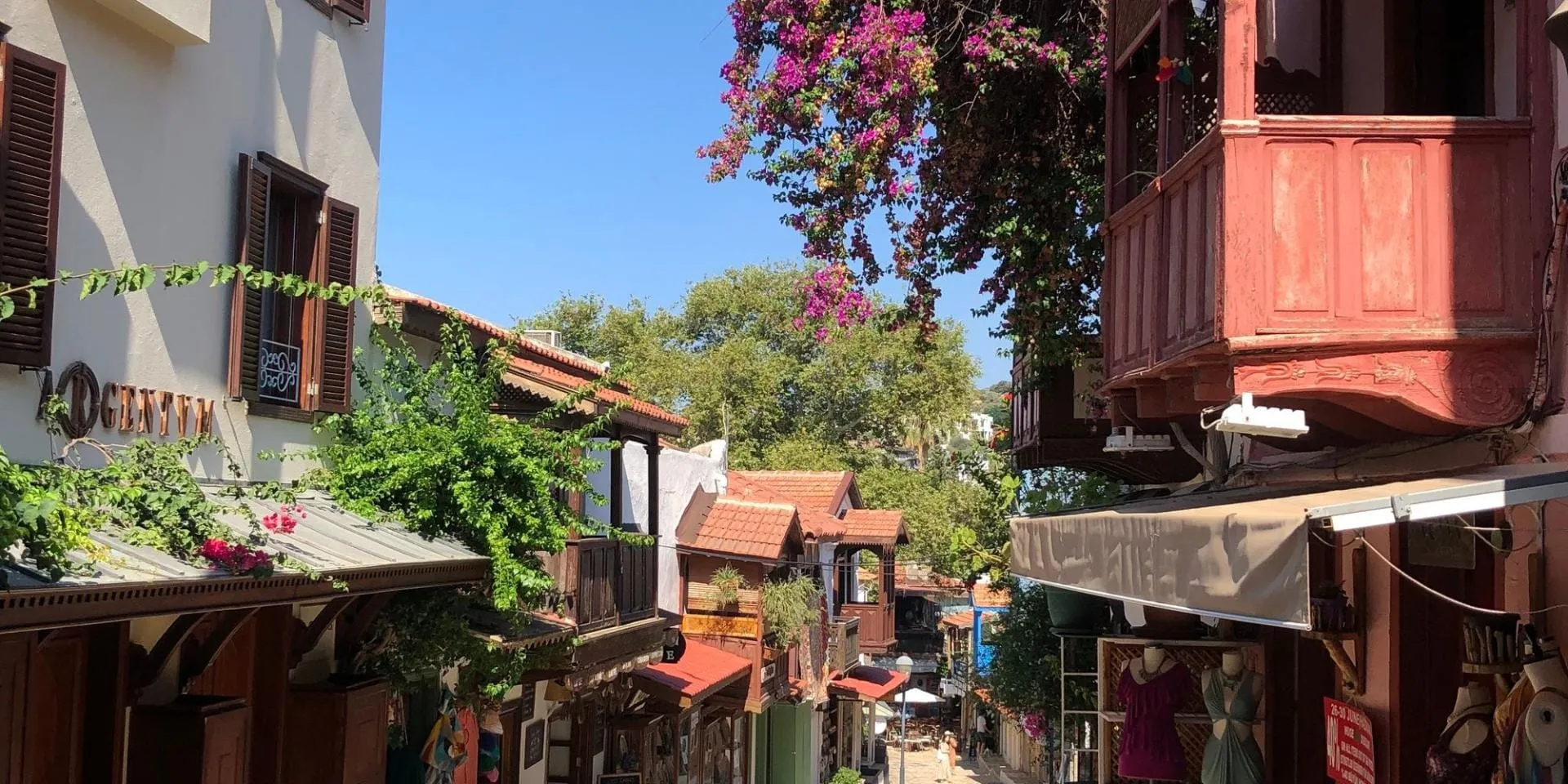
Bougainvillea, jasmine, geraniums, capers rooted straight into limestone, and citrus and olive in gardens you glimpse through gates.
Ruins in the street
A Lycian sarcophagus stands in the middle of a residential road, and rock tombs look down on the town from the cliff behind it. No fences, no ticket.
The Friday market
Produce from the villages inland, brought down that morning. Worth an hour whether or not you are cooking.
Weddings are public
When there is a wedding, the town is broadly invited. If you find yourself waved over to a table, that is not a mistake.
Winter is not dead
Quieter, greener, and about fifteen degrees. Some places close, the good ones do not, and the walking is better than in August.
The Holiday Runs on Impulse
Because everything is close and nothing is enormous, plans stay loose. Decide over lunch that you want to dive and you can be on a boat by two. Book a Kekova trip the night before while walking back with an ice cream. Change your mind about the beach twice in a morning and lose nothing but ten minutes of walking.
That is unusual. Most holidays are logistics with swimming in between. This one is not, and it is why people describe leaving Kaş as harder than arriving.
If you want the practical version of all this, our guide to places to visit in Kaş lists everything within reach, and where to eat covers the town properly. Luna Kaş sits a few minutes’ walk from the harbour, which is exactly the distance this article has been arguing for.
Frequently Asked Questions
Is Kaş good for a first visit to Türkiye?
Yes, provided you want a small town rather than a resort. It is walkable, safe, easy to navigate and English is widely spoken. What it does not have is a big-hotel infrastructure, so if that is what you are picturing, look further east along the coast.
Is Kaş suitable for families?
Very. The town is compact and easy to walk with children, the beaches are pebble rather than sand with clear shallow water, and boat trips break up the day. The main caveat is that the coast is rocky and there are few gently shelving sandy beaches nearby, apart from Patara.
When is the best time to visit Kaş?
May to June and September to October. The sea is warm, the light is better than in high summer, and the town is busy without being full. July and August are hot and crowded. Winter is quiet and green, around fifteen degrees, and good for walking.
Why is the sea cold in places?
The coast is limestone and fresh groundwater emerges through the seabed and along the shore. Where it does, the temperature drops noticeably within a metre. The same karst system also keeps the water very clear, which is part of why Kaş is a well-regarded dive destination.
Is there nightlife in Kaş?
Bars and live music, yes. Nightclubs, no. The evenings run late but stay low-key: dinner, then a bar, then the harbour. If a big club scene matters to you, this is the wrong town.
Do you need a car in Kaş?
Not for the town itself, which is entirely walkable. A car pays for itself if you want Kaputaş, Patara, Xanthos or the mountain villages without arranging each trip separately. Dolmuşes cover the nearer places well in summer.
HARD TO REACH, HARDER TO LEAVE
A small town, cold clear water and nothing much to organise.
Luna Kaş is a few minutes from the harbour.