

 Historical & Cultural Sites
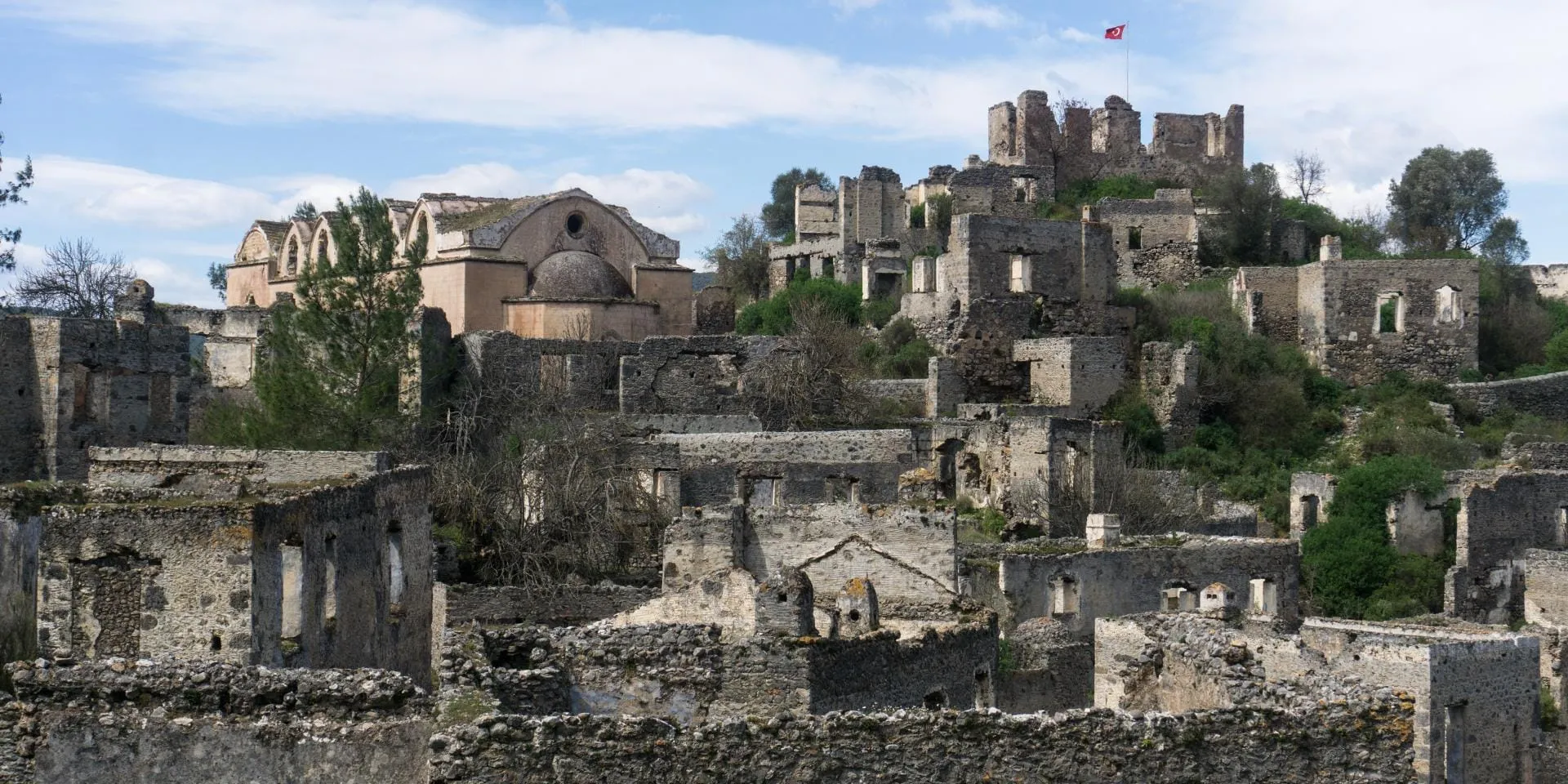
 Some five hundred stone houses climb a hillside above Fethiye, and not one of them has a roof. Kayaköy was emptied in 1923 and never refilled. What makes it strange is not the ruin, which is ordinary enough in this part of Turkey, but the ordinariness underneath it: doorways at head height, cisterns, a fountain, two schools, a chapel every few streets. This was a town, and then in the space of a year it was not. It is 117 km from Luna Kaş, which makes it a full day rather than an afternoon, and worth every hour of it.
Where Kayaköy Is and How to Get There
Kayaköy sits in Muğla province, 7 km from Fethiye and 10 km from Ölüdeniz, just north of the Ölüdeniz nature park. Hisarönü is 5 km away and Ovacık is closer still. From Kaş it is 117 km along the coast road.
By car: follow the coast road west through Kalkan and Fethiye, then turn south for the village. Give it a little over two hours each way.
By dolmuş: from Fethiye there is a dolmuş roughly every hour. You could walk it from the centre of Fethiye, but you will do plenty of walking once you arrive, so save your legs.
The site is run by the Ministry of Culture and Tourism. Bring your Müzekart or pay at the gate.
Since you are driving this far, build a day around it: swim at Ölüdeniz in the morning while the water is still cold, walk Kayaköy in the afternoon when the light goes long, and finish the evening in Hisarönü, which has the bars.
Karmylassos, Levissi, Kayaköy
The village has had three names, and each belongs to a different town on the same ground. It began as Karmylassos, a settlement of the Teke peninsula in the Lycian world, with finds reaching back four to five thousand years. Nothing you see today is that old. The houses on the hillside are nineteenth century and later.
Under the Ottomans the site was resettled and became Levissi. Graves show that Kayı and Karakeçi Yörük families were living in the area by the 1400s, and Greeks and Turks shared the valley for centuries after that. Levissi grew into a prosperous Greek Orthodox town: a pharmacy, a post office, a printing press that produced the local paper, Karya, and separate schools for girls and boys whose graduates went on to Istanbul, Athens or Rhodes.
Relations soured with the Anatolian unrest of the 1880s. Then, in 1923, after the War of Independence, Turkey and Greece signed the population exchange. Orthodox Christians left for Greece and Muslims in Greece came the other way, and Levissi emptied. Estimates of how many people lived here before that vary a good deal, from a couple of thousand at the turn of the century to figures nearer ten thousand; whichever is closer, the town did not survive their leaving.
Why It Feels the Way It Does
The people who left expected to come back. They did not take their belongings; they handed them to Turkish neighbours to keep. Nobody returned.
The families who arrived from Greece were farmers, and the Anatolian Greeks had built deliberately on rock and stone so as not to waste soil that could be planted. A village stacked up a stony hillside was no use to people who needed flat fields, and within a few years most of them had moved down to the plain. After that came the looters, and then, after an earthquake, people who needed building material and took the wooden doors and window frames away with them.
So the village was abandoned twice, by the people who were forced out and by the people who were moved in. That is the particular quiet you walk into now.
Film crews found it, inevitably. The Turkish horror films Ezan (2015) and 666 Cin Musallatı (2016) were shot here, and so were scenes of The Water Diviner (2014), Russell Crowe’s film about an Australian father searching for his sons after Gallipoli, with Olga Kurylenko, Jai Courtney, Cem Yılmaz and Yılmaz Erdoğan. In the house they used, someone hung photographs of the family who actually lived there. If it is open when you visit, they are still on the wall.
One more name from here: Nadir Nadi, long-time editor of Cumhuriyet and son of its founder Yunus Nadi Abalıoğlu, was born in this village.
What to Find in the Village
Take the marked paths; the stonework is protected and a good deal of it is loose.
The Upper Church
Taksiyarhis, the largest building left standing, and the one you can see from the road below.
The Lower Church
Panaghia Pirgiotissa, in better condition than the upper one because it served as a mosque until 1960.
Turabi Fountain
The old fountain that supplied the village's drinking water. Every house also had its own cistern for daily use.
The two schools
Girls above the Turabi Fountain, boys northwest of the Upper Church. Separate, and both teaching in Greek.
Fourteen chapels
Small cross-marked chapels scattered through the streets, roughly one for every few houses.
The windmills
Up on the ridge, built to grind wheat. Climb to them for the view down over the whole village, best near sunset.
Look at how the houses are placed while you walk. No house blocks the light or the view of the one behind it. Most are two storeys, the lower floor a cellar or a stable, the upper one or two rooms for living. It is a whole planning principle, worked out on a slope, and it still holds even with the roofs gone.
Behind the Village There Is Sea
Keep going over the ridge behind Kayaköy and you come down to the coves. Soğuk Su and Gemile have no road; you either arrive by boat or you walk, and the walk takes about an hour over the hill. On a hot day that is a real commitment, and the water at the other end is worth it.
The other walk from here is up to Afkule, a monastery built into the cliff with one of the great views on this coast. It is a similar distance and rather harder going. If you are not used to the Lycian Way, treat it as its own outing rather than something to tack onto an afternoon in the village.
The Village of Peace and Friendship
In 1989 the Chamber of Architects and the Turkish-Greek Friendship Association named Kayaköy a Village of Peace and Friendship, and it is described as a World Friendship and Peace Village. In 1990 an imam from Fethiye and a priest from Rhodes stood together in the church of the Virgin Mary here and prayed for the two peoples.
The last thing worth saying about Kayaköy is that it is not dead. The trees the villagers planted are still alive and still fruiting, and if you come in the right month the fig branches will be hanging over the walls of houses nobody has lived in for a hundred years.
Frequently Asked Questions
How far is Kayaköy from Kaş?
117 km along the coast road, a little over two hours each way. It is a full day out rather than a half day, so it pairs well with Ölüdeniz and Hisarönü.
Why was Kayaköy abandoned?
Its Greek Orthodox population left in the 1923 population exchange between Turkey and Greece. The farming families resettled here from Greece could not work a village built up a stony hillside and moved down to the plain, so it emptied a second time.
Is there an entry fee for Kayaköy?
Yes. The site is run by the Ministry of Culture and Tourism. A Müzekart covers it, otherwise you pay at the gate.
How do you get to Kayaköy without a car?
Dolmuşes run from Fethiye roughly once an hour. Fethiye is only 7 km away and the walk is possible, but you will cover a lot of ground inside the village, so the minibus is the better choice.
How long do you need at Kayaköy?
Two hours covers the village at a reasonable pace, including the climb to the windmills. Add an hour each way if you plan to walk over to Gemile or up to Afkule.
Was The Water Diviner filmed at Kayaköy?
Yes, scenes from the 2014 Russell Crowe film were shot here, as were the Turkish horror films Ezan and 666 Cin Musallatı. Photographs of the family who owned the house used in filming still hang inside it.
A LONG DAY, AND WORTH IT
Two hours there, a hillside of empty houses, and two hours back.
Luna Kaş will still be here, with the sea and something cold.