

 Historical & Cultural Sites
 In 545 BC the people of Xanthos did something that Herodotus never quite got over. Facing a Persian army they knew they could not hold off, they gathered their wives, their children, their slaves and everything they owned into the citadel, set it alight, and then marched out to die in the field. The Persian commander won the battle and inherited an empty, burning city. Twenty-five centuries later you can walk up that same hill, forty-five kilometres from Luna Kaş, and stand where it happened.
Xanthos was the largest city in Lycia and the administrative capital of the Lycian League. It has been on the UNESCO World Heritage list since 1988, together with Letoon, the sanctuary four kilometres down the road. If you are staying in Kaş for more than a few days, this is the ancient city to give a whole morning to. Buy a Müzekart before you come; it pays for itself quickly around here.
Where Xanthos Is and How to Get There
The site sits above the village of Kınık, in the Kaş district, 45 km from Kaş and 46 km from Fethiye. It is built on two hills looking out over the plain of the Eşen River. In antiquity ships came up to it; today the sea is eight kilometres away, because the river has spent two thousand years filling in the gap.
By car: follow the Kaş to Kalkan coast road and continue towards Kınık. Allow about an hour.
By dolmuş: take a Kalkan or Kınık dolmuş from Kaş, get off in Kınık, and walk the last kilometre up to the entrance.
The Siege That Made the City Famous
The Persian general Harpagos came for Lycia in 545 BC. Xanthos held out for a long time. When it became clear the walls would not hold, the men of the city made a decision that reads as either magnificent or unbearable depending on the day you read it: rather than let a single Xanthian be taken alive, they shut their families and their possessions inside the Lycian acropolis and burned it, then went out to fight until there was nobody left to fight.
Harpagos took the city and found nothing worth taking. Xanthos entered history as the place that destroyed itself rather than surrender, and it did the same thing again four centuries later when the Roman Brutus besieged it in 42 BC. Whatever else the city was, it was consistent.
Walking the Site
Two hills, each with its own acropolis and its own ring of walls, built in visibly different masonry. The first and lower one is the Lycian acropolis, the older of the two and the one that burned. The second is the Roman acropolis, higher and spread over more ground.
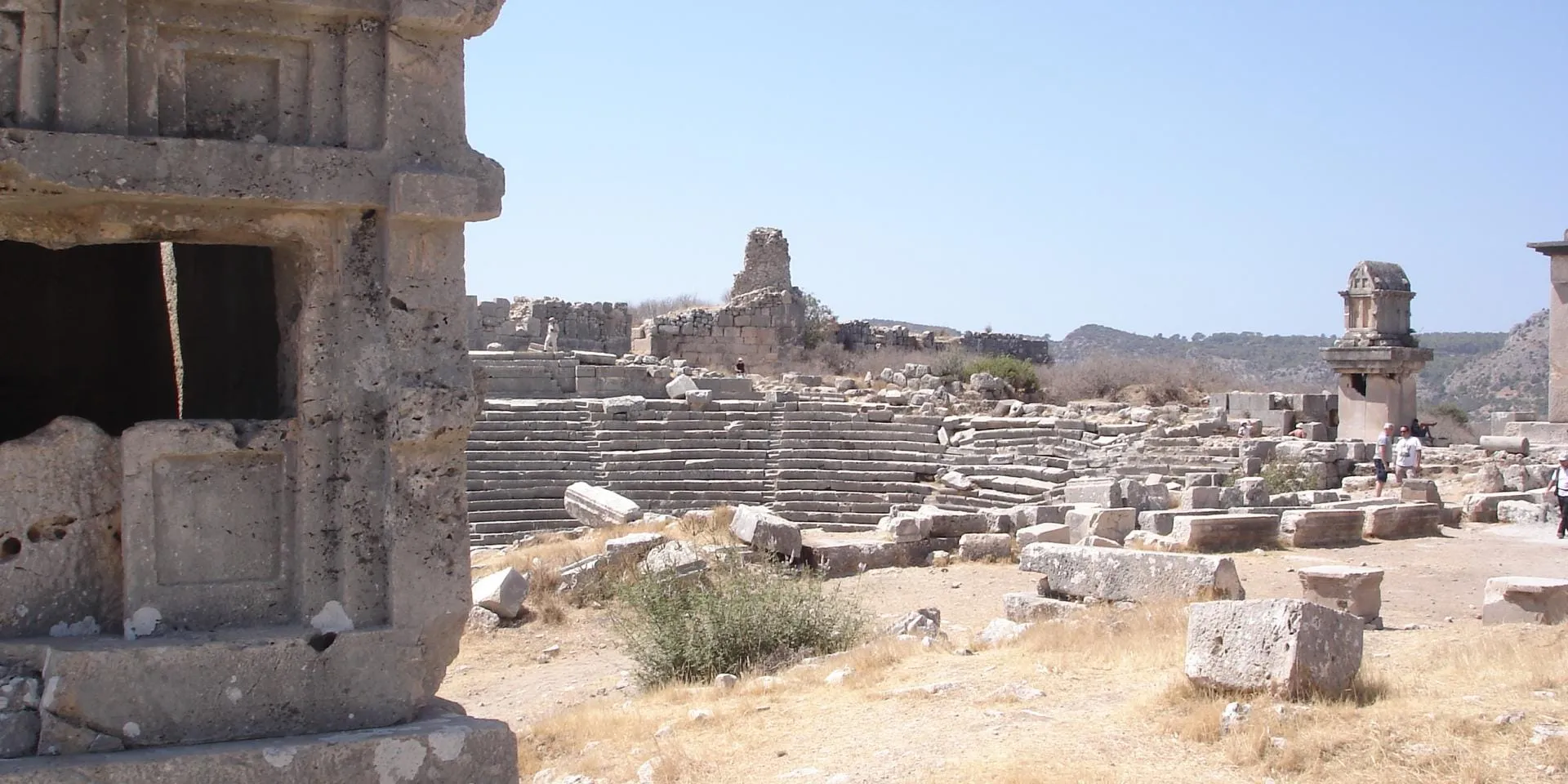
The Roman theatre stands on the north side of the Lycian acropolis, and the best of the ruins are in the ground just west of it. The Roman agora is right beside the theatre. Excavation has turned up three agoras in total, a broad main street, a council chamber, a palace, a large private house and a great many Roman monumental tombs.
What to Look For
Five things worth finding before you leave.
The Roman theatre
North of the Lycian acropolis, and the natural place to start. Everything worth seeing radiates from here.
The Harpy Tomb
A pillar tomb named for the half-woman, half-bird figures carved on it. What stands here is a cast; the originals are in London.
The Inscribed Pillar
Northeast of the agora. The longest known text in the Lycian language, alongside Greek, recording the deeds of a prince named Kherei.
The two acropolises
Lycian and Roman, side by side, in different stonework. The Lycian one is where the fire was set.
The sarcophagi
Pillar tombs and rock-cut tombs scattered across the site, the oldest reaching back to the 7th century BC.
What Is Here, and What Is in London
In 1838 a British traveller named Charles Fellows arrived in Lycia and identified the ruins above Kınık as Xanthos. Before him the Lycian civilisation was barely known in Europe; after him it was famous. He returned in 1840 and shipped more than seventy tons of sculpture and architecture back to England.
The Nereid Monument, the Payava Tomb, the F, G and H monuments and the Harpy Tomb reliefs are all in the Lycian gallery of the British Museum today. What you see on the hill in their place are casts and empty foundations. It is worth knowing before you go, so that the gaps make sense when you are standing in front of them.
The city’s own name for itself, in the Lycian language, was Arnna. Homer has the Xanthians fighting at Troy, which puts them in the story long before anyone was writing their history down.
Xanthos in Order
Twelve centuries on one hill, from the siege to the silence.
545 BC: Harpagos
475-450 BC: Fire again
334 BC: Alexander
2nd century BC: Capital
42 BC: Brutus
1st century AD: What you see
Byzantine era: A bishopric
After the 7th century: Quiet
There is very little shade on the site. Go early, take water, and wear something with a proper sole; the ground is uneven limestone.
Letoon, Four Kilometres On
Xanthos was the political capital; Letoon was the religious one. It shares the UNESCO listing and sits four kilometres away, which makes skipping it hard to justify once you have driven this far.
Three temples stand side by side there, dedicated to Leto and to her children Artemis and Apollo. Part of the site is usually under water, which sounds like a problem and is in fact the best thing about it: the columns stand in a still pool with frogs and reflections, and it is much greener and cooler than the bare hill you have just come down from.
Patara is close enough to add on the same day, which gives you the Lycian League’s capital, its sanctuary and its assembly building in one run, and eighteen kilometres of beach to finish on.
Frequently Asked Questions
How far is Xanthos from Kaş?
About 45 km, or an hour by car along the Kaş to Kalkan coast road. From Fethiye it is 46 km.
Can you get to Xanthos without a car?
Yes. Take a Kalkan or Kınık dolmuş from Kaş bus station, get off in Kınık village, and walk the last kilometre up to the site entrance.
Is Xanthos worth visiting?
If you have any interest in the Lycians, it is the single most important site on this coast: their largest city and the capital of their league, on the UNESCO list since 1988. Allow two hours, more if you continue to Letoon.
Is the Müzekart valid at Xanthos?
Yes, and it is worth buying if you plan to see more than one or two ancient sites around Kaş. Letoon, Patara, Myra and Tlos are all within reach.
Why are the famous Xanthos monuments in the British Museum?
Charles Fellows identified the site in 1838 and shipped over seventy tons of material to England in the 1840s. The Nereid Monument, the Payava Tomb and the Harpy Tomb reliefs are in the British Museum’s Lycian gallery. Casts stand in their place at Xanthos.
Can you visit Xanthos and Letoon together?
Easily. They are four kilometres apart, share one UNESCO listing, and make a natural half day. Patara fits on the end of the same trip.
COME BACK DOWN TO THE SEA
An hour inland there is a hill where a city chose fire over surrender.
An hour back, there is a cold drink on the terrace at Luna Kaş.